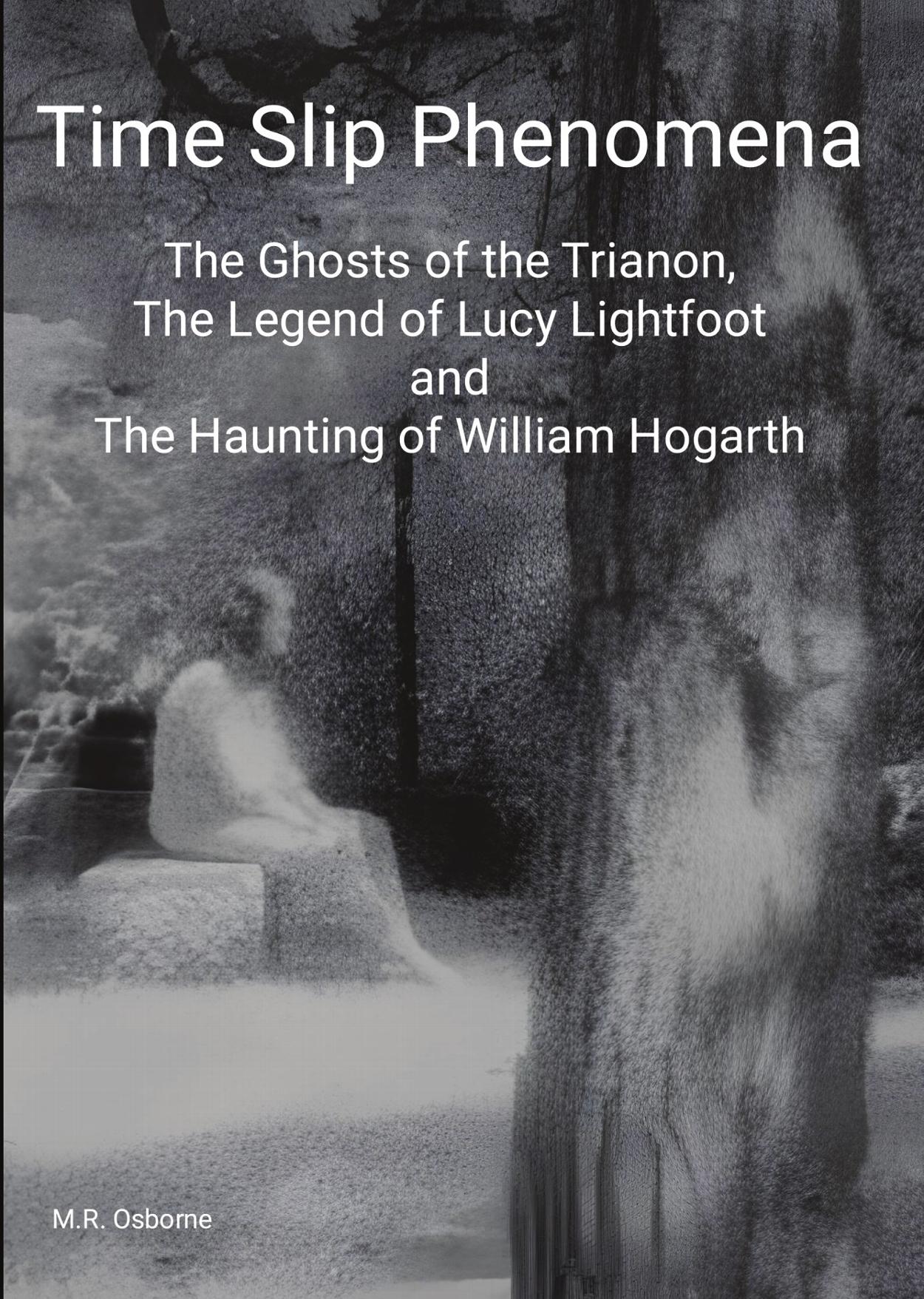
Now in its second edition, this expansive study examines the scientific and philosophical case for so‑called “time slip” phenomena through three remarkable case studies: the Versailles Time Slip, the invented but enduring legend of Lucy Lightfoot, and the haunting experienced by the artist William Hogarth during his 1749 visit to Northamptonshire.
The book asks the questions that lie beneath these stories: Does consciousness survive death? Is time fluid rather than fixed? Can the living and the long‑dead intersect across centuries? And what do current scientific and philosophical models allow—or forbid—when we explore such possibilities?
Clear, engaging, and rigorously researched, this edition offers readers a thoughtful investigation into one of the most intriguing frontiers of human experience. Available in paperback, hardcover, and Kindle.


What if the so‑called ghosts we encounter perceive us as the intruders—fearful, startled, and just as confused as we are? Perhaps they are not trying to frighten us with some morbid, spectral appearance; perhaps we are simply looking at each other across a divide neither side fully understands.
If that is the case, then intelligent communication becomes far more important than fear. Imagine what might be learned if we could cross that barrier—if two timelines, or even two dimensions, could briefly touch. Are these encounters glimpses into a parallel world, a mirrored version of our own, or simply moments when the corridors of time twist so closely together that one can peer through a fleeting “window” into a neighbour's reality? Whatever their nature, such experiences point to an aspect of existence far beyond the everyday. A single encounter can overturn our assumptions about a purely physical world, revealing instead a multidimensional reality that expands—and humbles—the mind.
This short book gathers several theories surrounding the phenomenon known as the “time slip,” exploring three compelling case studies. The first, The Ghosts of the Trianon—also known as the Versailles Time Slip or the Moberly‑Jourdain Incident—has undergone the most rigorous academic scrutiny by psychical researchers. The second, the Legend of Lucy Lightfoot, is a later fiction, yet it persists because it resonates with deep archetypal patterns in the human psyche. The third examines a largely forgotten account involving the eighteenth‑century artist William Hogarth, whose experience blends haunting with temporal distortion.
From Aristotle to Einstein, and even in the CIA's research into consciousness, the idea persists that time and space may not be a single, fixed continuum. Human beings experience time differently, and the nature of the mind itself may hold the key to the enduring question of whether consciousness survives death.
So begins a journey that lifts the veil on some of the strangest paranormal legends ever recorded. This book offers the clearest, most engaging introduction to the time‑slip phenomenon—without sensationalism. It brings together rare, scattered, and often misunderstood cases into one coherent narrative. The narrative blends history, psychology, physics, and folklore into a single, accessible exploration of how time may function. It invites readers to rethink the boundaries of consciousness, survival, and reality itself.
"He throws in ideas, and encourages you to make up your own mind from evidence and hearsay provided. Why did these legends begin? Were there any substantial occurrences that led to the 'invention' of the legends? Were they said to be invented because the truth was too incredulous? Were they in fact invented to cover up something else?"
5-Star Amazon Review
Join My Mailing List
Join the mailing list today to hear about upcoming books and lectures. If you have any questions on my books on Rosicrucianism, contact me by email author@mrosborne.co.uk.
This site is protected by reCAPTCHA and the Google
Privacy Policy and
Terms of Service apply.


